
Over the last twelve months, I have posted liturgies for some of the traditional ways to celebrate the changing seasons of the year, marking the turning points of the eternal cycle. This post offers an alternative to that, and is based on the feasts of the Northern people, the ancestors of many of we north Europeans. The pivotal points of the year are not based on calendar dates as such, but on an awareness of and connection with what is happening in the natural world - and even those of us who live in cities can surely find those essential links and be blessed by them. Another difference is that I am not here offering liturgies for the festivals, but things to do. I hope you may enjoy doing them... Put them in your diary or on your calendar, so you don't forget.
To start off with, here are the names of the months
of the year, according to Roman, Anglo-Saxon, Frankish, and Norse traditions:
January,
After-Yule, Winter month, Snow-moon
February,
Mud month, Short month, Horning
March,
Noise month, Lengthening month, Lenting
April,
Eostre's month, Ostara's month, Ostara
May,
Three Milkings, Joy month, Merry-moon
June,
Dry month, Plough month, Midyear
July,
Meadow month, Hay month, Hay-moon
August,
Weed month, Harvest month, Harvest
September,
Holy/Harvest month, Wood month, Shedding
October,
Winter full moon, Grape harvest moon, Hunting
November,
Sacrifice month, Harvest month, Fog-moon
December,
Fore-Yule, Holy month, Yule
Below is a 'Viking Calendar'
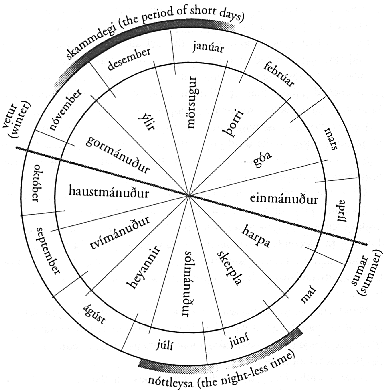
For the people of the North, the year did not begin in what we know as January, but at the end of autumn. However, since I am posting this at the beginning of our Advent, I am choosing to begin at the end of the dark and cold Winter months, with the first of the Rites of Spring: Summer
Finding.
This could occur either around the Spring Equinox (around the third
week of March) or any time during the first half of what we know as
April. The significant 'findings' were the first flower of Spring,
such as the violet, and/or the return of certain birds, such as the
cuckoo, stork, or swallow, from their winter roosts. The later
practices of both Easter and May Day derive from this festival time:
for example, the hare, sacred to the goddess Ostara/Eostre, became
the "Easter Bunny", and Hot Cross Buns derive from the
ritual bread marked with the image of the horns of the ox sacrificed
at the feast. The very word 'bun' derives from the Saxon word 'boun'
meaning 'sacred ox'.
What
to do:
Keep a keen look out for the first signs of Spring - and, if it's a
flower, don't pick it! Take a photo and put it up somewhere you'll
see it every day.

Walpurgisnacht,
the end of the period of the Wild Hunt (see Winter Nights, below) occurred around the end of
April. Once a nine night festival, it was a remembrance of Odin's
self-sacrifice on the World Tree, Yggdrasil. It was on the ninth
night that he beheld the Runes, grasped them, and ritually died for
an instant, during which all the Light in the Nine Worlds was
extinguished and Chaos reigned before the Light returned (on the last
stroke of mid-night) - marked by the lighting of bale fires.
What
to do:
Remind your self of something you've wanted to do or learn or see, and set whatever is needed in motion so that you get to do it - not necessarily hanging from a tree :-)

The
Sun's Wending
or Summer Solstice, like Walpurgisnacht, also contains an element of
the commemoration of the dead, in this instance Odin and Frigg's son
Baldr ('Beloved'), killed by Loki ('Knot'/'Tangle'), and of the hero
Sigurd, whose story is thought to derive in part from the history of
one of the Merovingian kings of the Franks, Sigebert. Despite this,
the festival was kept with dancing, feasting, burning wheels, and
bonfires, into which were cast garlands, herbs and blue flowers, such
as larkspur, as a sign of throwing off an ill-fortune. Cattle were
sometimes driven through the smoke of the fires, to cleanse or purify
them.
What
to do:
Watch the sun set, and either stay up all night or get up early
enough to see it rise. And treat your self to a really nice
break-fast!

Þing-tide
was celebrated
around
the third week of August. The þing
(pronounced
'thing') also known as Alþing,
was an assembly or meeting, held, unsurprisingly, at the þingstede.
In
Anglo-Saxon terms, it was a folk-moot, or folk meeting, during which
legislation was laid down, chieftains and kings elected (one person,
one vote), and legal judgments made. The annual public assembly of the
Isle of Man, during which new Max laws are read out and petitions
delivered, derives its name, Tynwald, from the þingvellir.
Elsewhere, it became known as the wapentake.
What
to do:
Send a card (yes, a real one, not an e- one) to someone you regret
losing touch with, just to say you're thinking of them, and including
your current contact details.

The
Feast
of the Wains
(wagons)
takes place around the time of the Autumn Equinox (known in some
circles as 'Mabon') and the Harvest Moon, and was in honour of those
gods associated with fertility, wisdom, and the future. One custom
which survived the Christian conversion was the leaving of some of
the harvest for the gods and/or spirits, for example, the last clump
of corn, or the last five or six apples. The reserved crops were
decorated with ribbons, and from this arose the tradition of the Corn
Maiden and the making of corn dollies.
What
to do:
If you have anything that you can harvest - herbs, fruit, veg,
flowers - then harvest it, but leave a small portion, and decorate it
with a ribbon.

Winter
Nights
occurs about a (lunar) month later, and was
regarded as the start of winter. In the old days, this was celebrated
with a feast and with prayers for a good winter, and both the spirits
of the land and the ancestral guardian spirits were honoured, along
with the remembrance of the dead and of one's ancestors. This
festival was incorporated by the Christians as All Souls Day - the
'Commemoration of the Faithful Departed'. Winter Nights also marked
the beginning of the Wild Hunt, which would continue until
Walpurgisnacht (1st May) - a procession of the dead led by Odin (also
revered as Wotan) on his eight-legged horse Sleipnir ('Slippy'),
accompanied by dogs and horses, riding through the winter storms.
What
to do:
Plant something in memory of the people you love who have died, and,
as you tend it and watch it grow, remember them with thankfulness.

Modraniht,
Mother Night, is held on the night before the start of Jol -
corresponding to Christmas Eve - in honour, of course, of mothers.
Food was left out for the departed mothers and other ancestors, as
well as for the álfar
(elves) and for the
Wild
Hunt, and children would hope to receive a gift in return for this
kindness - another link with Santa Claus and his elvish assistants.
What
to do: Take time to appreciate your own mother and grandmothers, and, if you
have them, your daughters. Do something today to show that appreciation and love.

Jól
(Yule) starts around the time of the Winter
Solstice. The title of the feast may derive from Jólnir
- one of the names of Odin (Óðinn),
the All-Father (Alfaðir),
the vital force of the vital forces which were personified as the
gods, the breath of life, will, and power. According to legend, Odin
played a part in the creation of the world, by the slaying of the
primordial being Ymir, and granting the gift of life to the first two
human beings, Ask and Embla, who were also given Midgard (Middle
Earth) for their dwelling, and who were the father and mother of all
people.
Some
of our current Christmas customs find their roots in Jól: the
lighting of the Yule Log (somewhat down graded to a chocolate cake!),
singing, visiting one another's houses, Father Christmas/Santa Claus,
riding across the sky in his sleigh drawn by reindeer - a gentle
version of the Wild Hunt - and, of course, feasting.
The
original feast centred around the boar (hence that mysterious Boar's
Head Carol!), a creature associated with Freyr, the god of sacral
kingship, over which solemn, holy oaths for the coming year would be
made - which have dwindled down to our often desultory New Year
Resolutions. According to some legends, the eve of the Solstice was
when Freyr himself rode over the world on the back of his shining
boar, bringing back Light and Love. Later the same eve was celebrated
as the birth-night of the god Baldur... and, of course, it is when
Christians celebrate the birth of Jesus. So it is at this darkest
time of the year when the brightest hope re-enters the world.
What
to do:
Light a candle, and let it burn out naturally (and safely please!)


